ELI5 · Part 7 of 7
Why the standard lasts
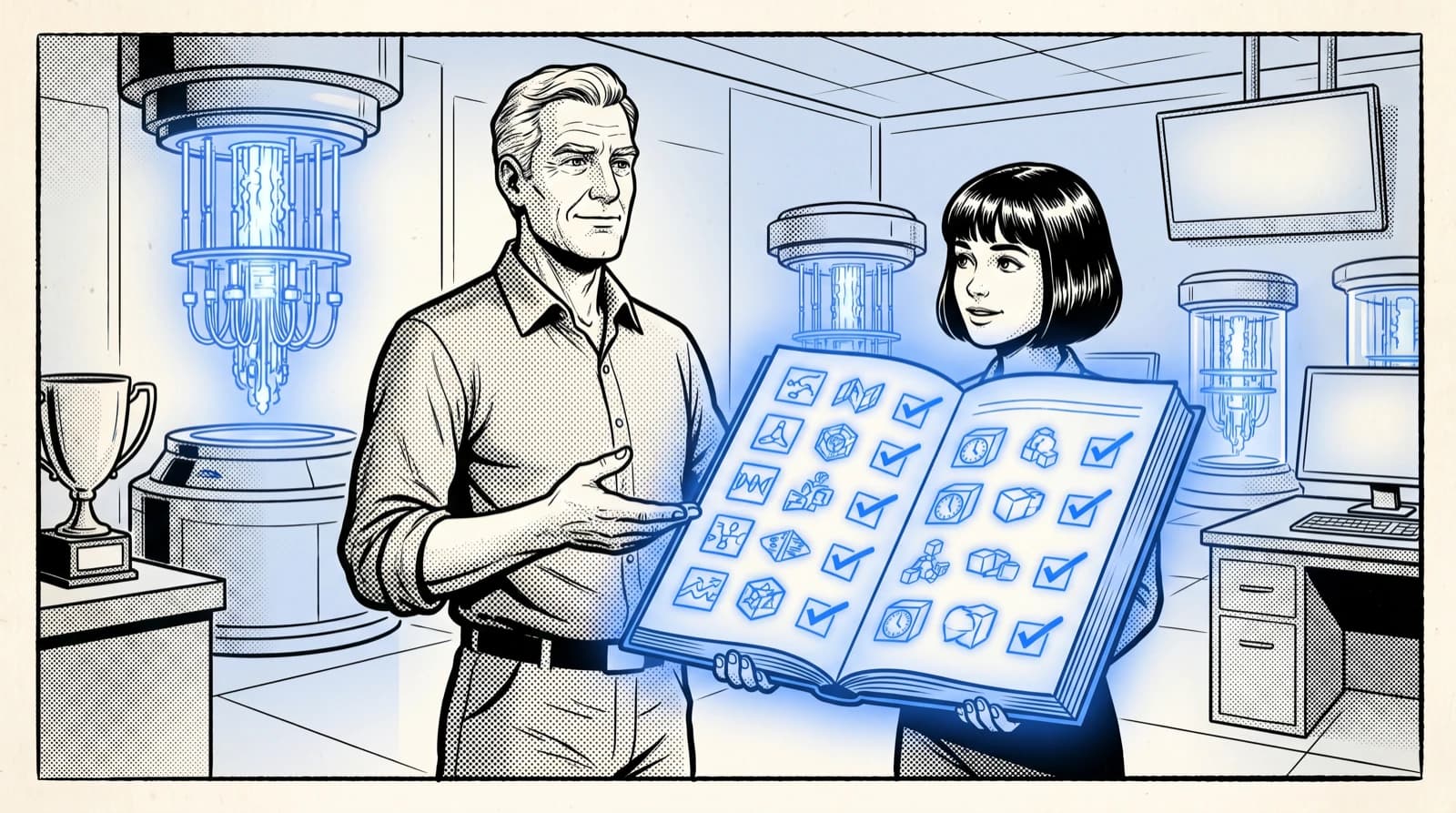
A proof you make today might need to hold up in thirty years. Picture a scientific discovery whose claim to being first still has to check out decades later, or an archive of contracts someone must verify long after the people who signed them have moved on. For a proof like that, "it works today" isn't good enough. It has to keep working long into a future nobody can see yet.
That's a real problem, because the math behind these proofs doesn't stand still.
Good methods don't stay good forever
Every cryptographic method rests on some calculation that is easy to do but practically impossible to undo. Over time, two things happen. Computers get faster and researchers get cleverer, so a method that looked rock-solid can slowly weaken. And entirely new methods get invented that are stronger than anything we had before.
So any honest standard faces a hard truth: the best method available today will not be the best method forever. A new and better one is always coming.
Why hard-wiring one method would be a trap
Imagine a standard that simply said, "always use this exact method." It would work beautifully — right up until that method weakened. Then you'd be stuck. To move to something better, you'd have to rewrite the rules, get everyone to switch on the same day, and somehow deal with every proof ever made under the old rules. That kind of "everybody change at once" moment is exactly the sort of thing that breaks history and strands old records. A standard built that way is quietly rotting from the moment it ships.
Label 309 sidesteps the whole trap by never naming a single fixed method in the first place.
A catalogue you keep adding to
Instead of baking in one method, Label 309 refers to each method by a name drawn from an open list — a registry. Think of it like a parts catalogue. Every proof records which "parts" it was built with — which method did the fingerprinting, which one did the sealing, which one signed it — by name.
There's a separate catalogue for each kind of part (one for hashes, one for sealing, one for signatures, and so on), and adding to one is strictly an addition:
- the new method has to be a real, published standard with a public reference (an RFC, a NIST publication, and the like) — no home-grown cryptography allowed;
- it gets a new name in the catalogue, with a test that pins down exactly how it behaves.
When a stronger method comes along, you don't tear up the catalogue or reprint the old pages. You add a new page. The old pages stay exactly where they are, forever. And here's the quietly clever bit: every proof ever made keeps the original parts listed on its own page. Look up an old proof, and the catalogue still tells you precisely how to check it — because its parts were never removed, only joined by newer ones.
So two things are true at the same time:
- Old proofs keep verifying. A proof made years ago still names methods that are still in the catalogue, so it checks out today just as it did the day it was made.
- New proofs can pick the newest method. Whoever makes a fresh proof simply chooses a newer name from the list.
There is no flag day. No moment when everyone must switch together. No broken history, and no scramble to convert a mountain of old records. The change is pure addition — a new entry on the list — never a replacement. Adding one doesn't even change the version of the format: a verifier that has never heard of a new name just cleanly says "I don't support that one yet," instead of crashing or guessing.
How the quantum jump happens, too
You may have heard that powerful new computers could one day break some of today's cryptography. (There's a companion article on exactly that.) The reassuring part is that defending against it needs no special rescue plan in Label 309 — it's the same move as every other improvement: name the new, quantum-resistant method in the catalogue. In fact it has already happened once: the post-quantum sealing method was added right next to the classical one, so new records reach for it today while old ones carry on untouched. A threat that sounds like it should demand a ground-up rebuild turns out to be just another page in the catalogue.
Built to outlive its own methods
The methods inside any proof will eventually be retired — that's normal, and Label 309 expects it. What lasts is the catalogue itself: an open set of registries you only ever add to, where every proof keeps its original parts on file forever. See the algorithm registries for how they grow without ever leaving an old proof behind.