ELI5 · Part 5 of 7
Who can read it, and what stays private
Sometimes you don't want to prove something to the whole world — only to a few people. Co-authors on a discovery you're not ready to announce. The parties to a confidential contract. A friend you're trusting with a secret recipe. You still want the permanent, tamper-proof timestamp a blockchain gives you. You just don't want strangers reading along.
Label 309's sealed proofs solve this. You lock the content so that only the people you choose can open it, and you anchor a timestamped record of it on the public ledger anyway. The natural worry is: it's a public ledger. Anyone can look. So what do they actually see?
The honest answer is: surprisingly little. But not nothing — and Label 309 is careful to be precise about the difference.
Picture a row of locked boxes
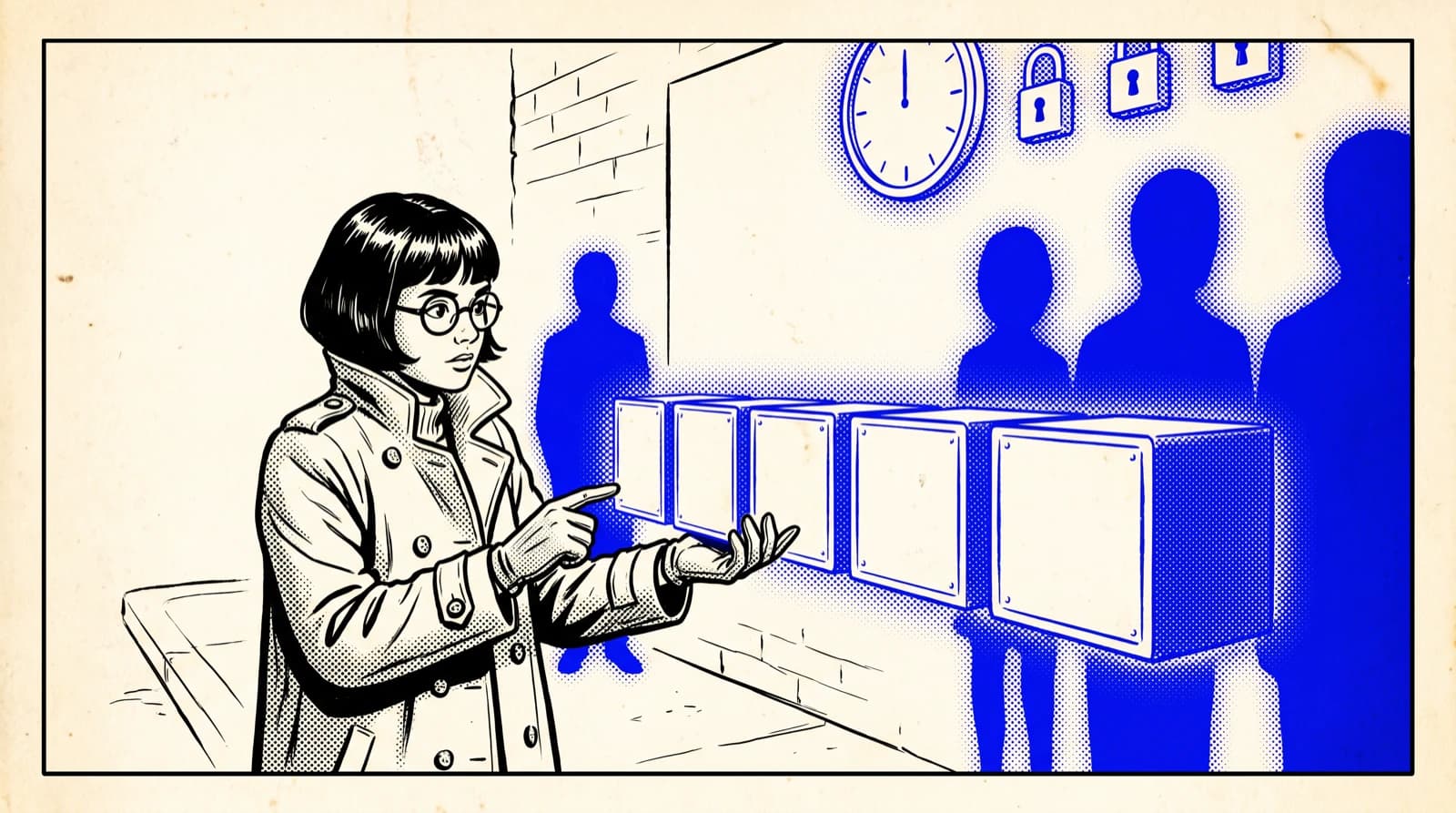
Imagine you put your sealed message in a vault wall that everyone can walk past. On that wall is a row of small, identical locked boxes — one for each person you're sending to. Each box holds a key that opens the same message, but each box can only be unlocked by one specific person's private key.
A passerby can see the wall. They can see there's a row of boxes. They can even count them. What they can't do is open any box, see whose key fits which, or read a single word of what's inside.
That's almost exactly how Label 309 sealing works.
What a stranger can see
- That something was sealed. The record openly marks that it carries locked content rather than being in the clear. (A watcher can even tell whether you used ordinary or post-quantum-safe locking — but nothing more.)
- The timestamp — the moment the network agreed the record existed, accurate to the second. That's the whole point; it's meant to be public.
- The content's fingerprint — the same one-way code from an ordinary proof of existence. It reveals nothing about the content itself and can't be turned back into it.
- Roughly how many recipients there are — the number of locked boxes. This is the one thing that leaks, and we'll come back to it.
What stays hidden
- The actual content. It's never on the ledger — only its fingerprint and the locked boxes are, and the scrambled file itself lives off-chain. Without one of the matching private keys, the content is just noise.
- Who the recipients are. Label 309 puts no recipient's name or public key anywhere on the record. There's no "to:" field to read. A recipient only discovers a message is theirs by quietly trying their key on each box until one opens. (One honest fine-print: if an observer already holds the exact public address of someone they suspect, the classical X25519 lock still won't confirm it for them — but the default post-quantum lock doesn't make that particular promise. See the caveat below.)
- Who sent it — if you choose not to sign. Signing your authorship is always optional in Label 309. Skip it, and the record carries nothing that ties it back to you: every box holds only fresh, one-time key material that points at no one.
And two subtler protections matter just as much:
- Recipients can't see each other. Opening your own box tells you nothing about anyone else's. You can't learn who else was included, and they can't learn about you.
- The order is shuffled. Before publishing, the boxes are scrambled into a random order. So even the position of a box — first, last — leaks no hint about who's "primary" or how the group is arranged.
The one honest caveat
The count is visible. A stranger can't tell who your recipients are, but they can count the boxes and learn how many there are. For most uses that's harmless — three co-authors, two parties to a contract. But if even the number is sensitive, you can blunt it: add a few extra boxes as padding, or split the sending into separate records. Label 309 doesn't hide the count for you, so when it matters, that's your move to make.
One more honesty about hiding who a box is for. The classical X25519 lock is
provably "key-private": even an observer holding a list of suspected recipients'
public addresses cannot test which box — if any — is addressed to one of them. The
default post-quantum lock (X-Wing) hides the same things from an ordinary stranger,
but Label 309 does not claim that stronger guarantee for it: against an
adversary who already has your suspected recipients' exact public keys, only the
classical lock promises to defeat the test. If that specific threat is yours,
choose the classical age1… keys for the seal; otherwise the post-quantum default
is the right call.
Two smaller honesties, while we're being precise. The timestamp is exact to the second, so for a leak where timing alone is sensitive, that itself is a real exposure. And the record can't hide which wallet paid for the Cardano transaction — that lives in the transaction itself, outside the sealed record, so anyone who needs that hidden has to handle it at the wallet level.
It's also worth remembering that anyone you do give a key to can read the message for as long as the stored content exists. Sealing protects you from the world, not from the people you chose to trust.
Strong privacy, one small leak — stated plainly
Label 309 sealing hides the content, who the recipients are, and (if you don't sign) even you. The single thing a chain watcher reliably learns is roughly how many people you sealed it for. The one fine-print: against an adversary who already holds a suspected recipient's exact public key, the strongest "can't even confirm it's them" guarantee is claimed only for the classical X25519 lock, not the post-quantum default. For the full treatment, see the security model.