ELI5 · Part 4 of 7
Sealing a file "until claimed"
A plain Label 309 proof stamps a date on a fingerprint and shows the whole world that something existed by a certain moment. But sometimes the timing isn't the only thing you care about. Sometimes you also want to share the actual content — but only with one specific person, and not a second sooner than they choose to open it.
Label 309 calls this a sealed proof, and it lets you do exactly that. You can publish a scrambled file out in the open, addressed to one or more particular people, and stamp it with a public date. Everyone can see that something was sealed, and exactly when. But the content stays locked until the right person opens it with their own key.
A locked box in a public square
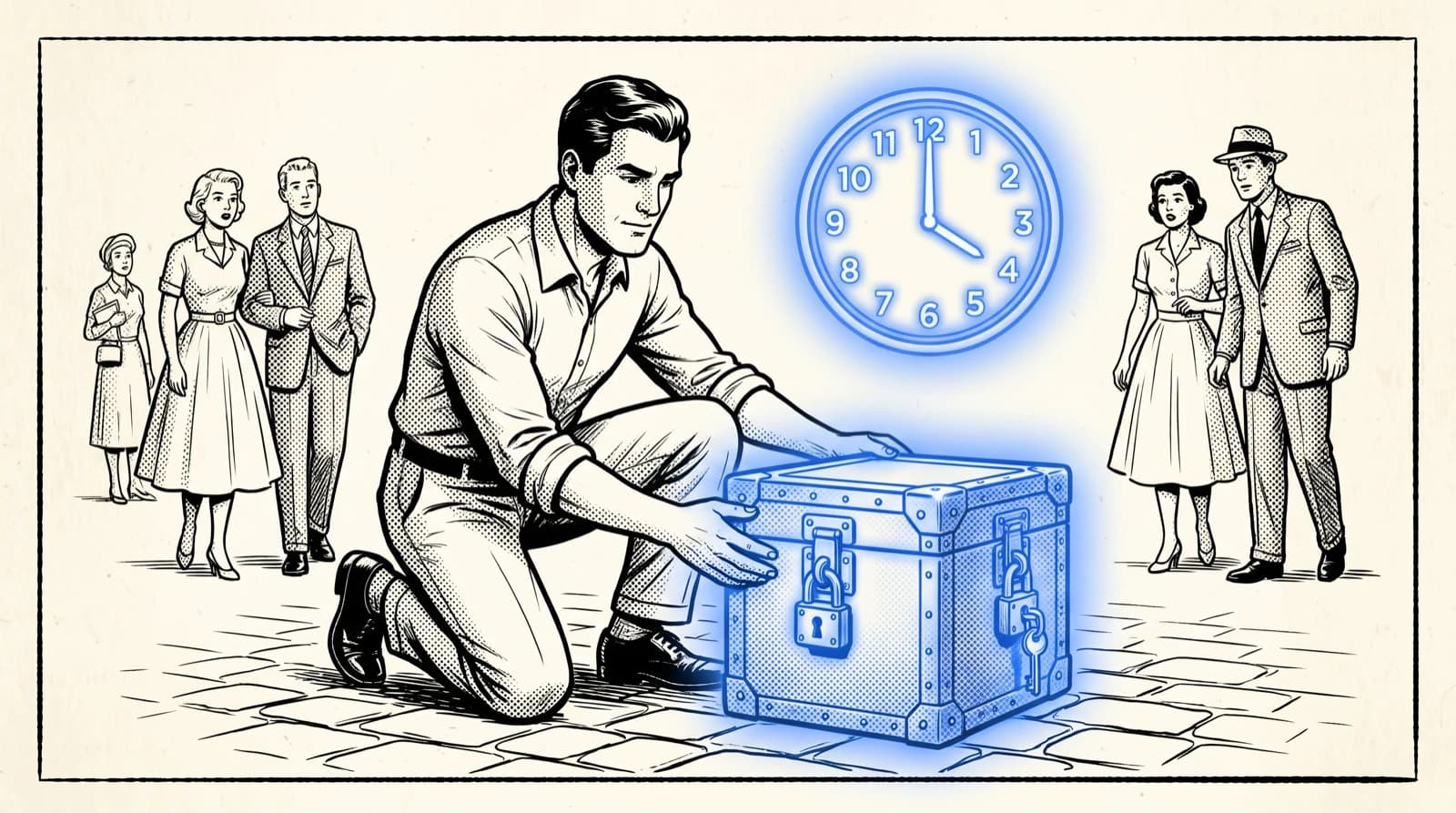
Picture a sturdy locked box left in the middle of a busy square. Anyone walking past can see it. Anyone can read the time it appeared. They can pick it up, shake it, study it from every angle. None of that helps them — without the right key, the box simply will not open.
That's what a sealed Label 309 proof is. The scrambled content is the box. The public timestamp is the moment it was set down in the square. And the key belongs only to the person you sealed it for.
This is how a discovery can be shared with a co-author before publication, a recipe handed to a business partner, an invention disclosed to a lawyer, or a confidential contract delivered to the other side — each one stamped with a date nobody can fake, yet readable only by the people meant to read it.
The date is public, the content is private
The two halves of a sealed proof live in completely different places, and that's the whole point.
- The date is for everyone. It sits on the Cardano blockchain under label 309, the same tamper-proof record any ordinary proof uses. No one can move it, back-date it, or quietly erase it.
- The content is for one audience. The scrambled file itself is stored separately — on permanent, content-addressed storage such as Arweave or IPFS — and it is gibberish to anyone without the matching key. The blockchain holds only a small locked-up copy of the key, one per recipient: never the file, and never their names.
The file is encrypted just once, and that single lock is then wrapped individually for each person you're sending to. So a passer-by learns one thing and one thing only: that a sealed message appeared at a certain time. They cannot read it, and there is no name on it to tell them who it was for.
Held "until claimed"
Here's the quietly clever part. Nowhere on the box is there a name tag. There's no "to:" line for a stranger — or even for the recipient — to read. Label 309 puts no recipient address on the record at all. Instead, the message waits in the open like a letter held at the post office until the right person comes to collect it.
How does that person know a message is waiting for them? They simply try their key on each locked copy. If one turns, the message was theirs all along. If none does, they learn nothing — not even that they were ever a possibility. Only an intended reader discovers it, just by trying. (One precise caveat: with the classical lock, even a stranger who already holds a suspected reader's exact address still can't confirm a copy is theirs; the default post-quantum lock hides the same things from an ordinary onlooker but doesn't make that one stronger promise. The fuller picture is in Who can read it.)
Several people, several keys
You don't have to seal a file for one person at a time. You can address the same sealed proof to several people at once — a co-author and an editor, two partners, a client and their lawyer.
Each person opens it with their own key. They don't share a secret, and they never see each other's keys. Before the record is published, the locked copies are even shuffled into a random order, so one recipient opening the box learns nothing about who else was invited — not even how the group was arranged. Each reader gets their own quiet, private way in.
What's public, what's not
A sealed Label 309 proof shows the world that a message existed at a certain time — plus the content's fingerprint and roughly how many recipients there are — and nothing more. The content stays unreadable, and no recipient's address appears on the record, until the right key opens the box. And because the record always commits to the plaintext's fingerprint, a recipient who opens it can prove exactly which content was timestamped. For who can and can't read these files — including the one privacy guarantee that differs between the classical and post-quantum locks — see Who can read it; for the full construction, the technical write-up.