ELI5 · Part 3 of 7
Your keys, simply
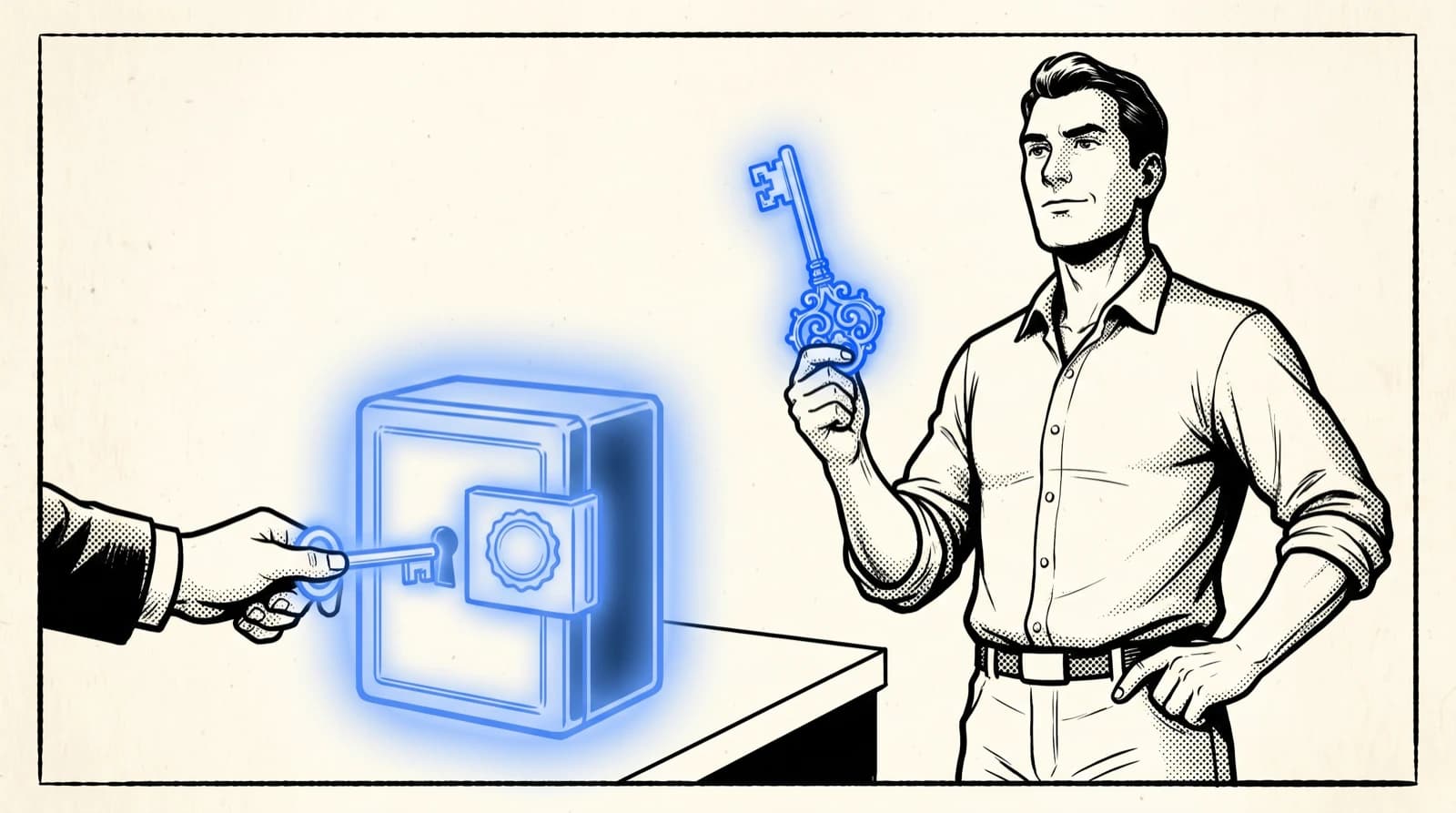
Behind every signature you make and every sealed file you receive, there is one small secret. You don't have to manage a drawer full of passwords, one for each task. In Label 309 you hold a single thing — a master seed, just 32 random bytes — and everything else is worked out from it.
Think of an old-fashioned master key that a locksmith uses to cut a handful of specific keys. You keep the master to yourself, locked away. The specific keys it produces each do one job. You never hand out the master, and you never have to.
One secret, a few jobs
Your master seed is just a string of random numbers that nobody else has. On its own it isn't tied to any particular task. From it, your device quietly works out the keys you actually use — always the same keys, every time, from the same seed. Label 309 derives exactly three:
- A key for signing — putting your personal stamp on a record so that anyone can tell it really came from you. (This one uses Ed25519, the same kind of signature Cardano wallets already speak.)
- A key for receiving ordinary sealed files — so that someone can lock a file in a way that only you can open.
- A key for receiving future-proof sealed files — the same idea, but using post-quantum-safe cryptography (more on that in Future-proof against quantum computers).
You don't generate these separately or write them down one by one. They all come out of the same master seed, in exactly the same way, every time. Reproduce the seed and you reproduce every one of them. Lose it and they're gone for good — so it's the one thing worth guarding above all else. (How you store and unlock that seed is left to each app; the standard only fixes how the keys come out of it.)
Public halves you can share
Here is the part that surprises people. Each of those working keys comes in two matching halves: a private half and a public half.
The private halves stay with you, right alongside the seed. They never leave your hands. They're what let you actually sign and actually open sealed files.
The public halves are different — they're made to be shared. Think of a
public half as your address. Label 309 even writes the receiving ones in a
friendly, copy-pasteable form (they start with age1…, or age1pqc… for the
post-quantum one). You can hand it to anyone, post it anywhere, print it on a
card. With it, other people can:
- Check your stamp. When you sign a record, anyone holding your public half can confirm the signature is genuinely yours.
- Send you something sealed. Anyone with your public half can lock a file so that only your matching private half can unlock it.
And that's all they can do. A public half can't be used to forge your stamp, and it can't open anything sealed for you. Handing it out is as safe as giving someone your street address: people can send you mail, but they can't move into your house or sign letters in your name.
Why split it into separate jobs
You might wonder why there's one key for signing and different ones for receiving sealed files, instead of a single all-purpose key.
It's the same reason you don't use one key for your front door, your car, and your safe. Label 309 keeps the jobs cryptographically walled off from each other, so a weakness in one can never spread to the others. The key that proves you wrote something is sealed away from the keys that let people send you private files. They all trace back to the one seed, but each stands on its own.
It also keeps you ready for the future. If a better kind of lock comes along years from now, your device can work out a new key from the same seed — no need to start over with a brand-new secret. That's exactly how the post-quantum receiving key was added: same seed, one more key.
The one thing to keep safe
Guard the master seed and the private halves; share the public halves freely. The public ones let the world check your stamp and send you sealed files — but they can never impersonate you or read your mail. If you'd like the precise mechanics, the Keys reference spells them out.