ELI5 · Part 1 of 7
What "proof of existence" really means
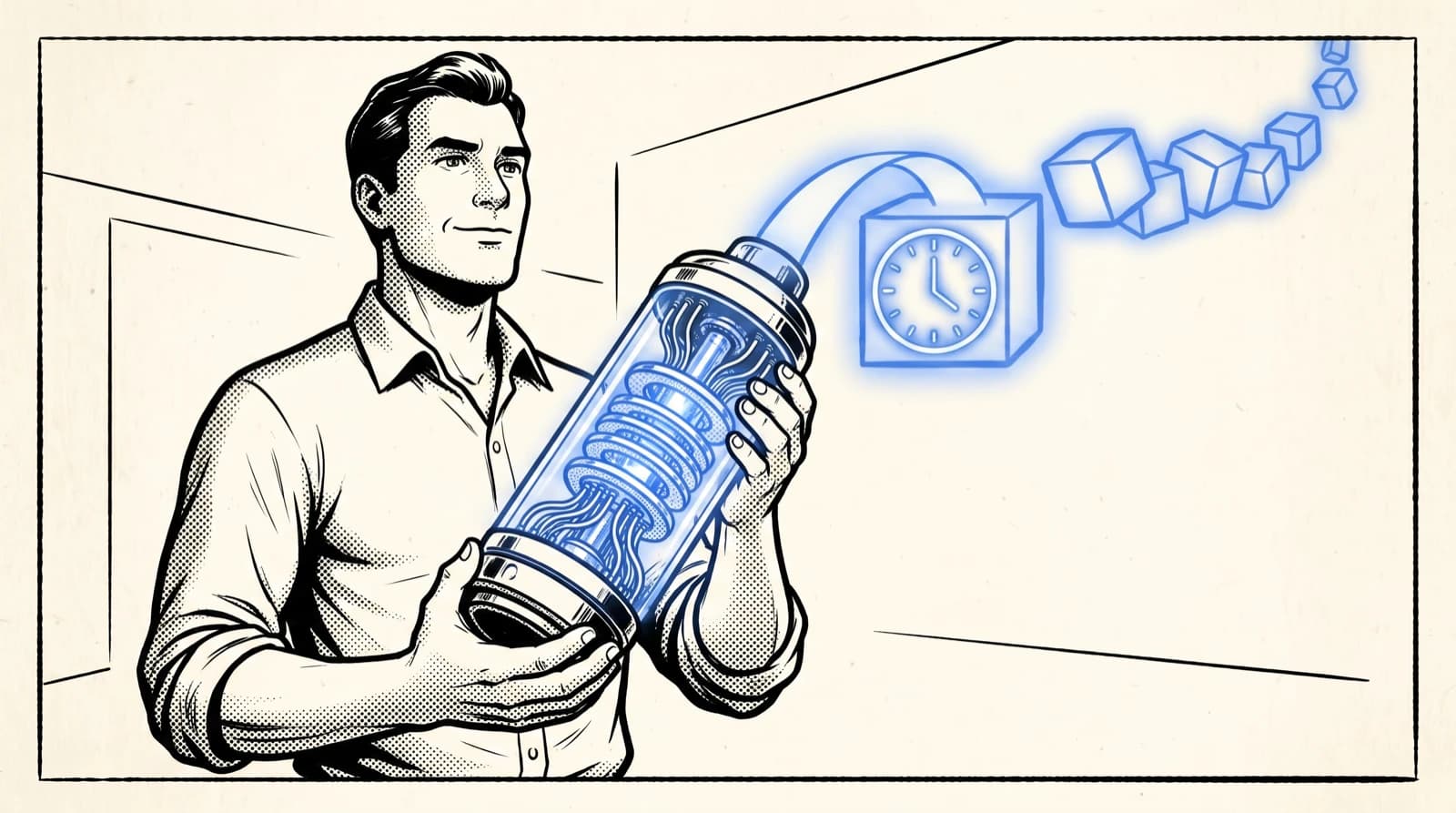
Suppose you come up with something worth protecting — a scientific result, the recipe for the best pie anyone has ever tasted, a new invention, the draft of a contract, or a photograph. One day you might need to prove it already existed on a certain date: that you had it first, before anyone else claimed it as their own.
The obvious tricks don't really work. Emailing it to yourself, or posting it somewhere with a date, all rely on a clock someone could fake or a company that could quietly edit the record later — and they force you to hand your secret to whoever you're trusting to keep the timestamp honest.
Label 309 is an open standard that solves this — and it solves it without ever revealing the thing itself.
A fingerprint, not the file
The first thing Label 309 does is run your content through a hash function — a one-way calculation that turns a file of any size into a short, fixed-length code. The standard uses well-known hashes (SHA-256 or BLAKE2b-256); either way the result is just 32 bytes. Think of it as a fingerprint: it is unique to that exact content, and if even a single character changes, the fingerprint comes out completely different.
Two things make the fingerprint useful:
- It can't be reversed. Nobody can reconstruct your recipe or your invention from the fingerprint alone.
- It can't be forged. Nobody can cook up a different file that produces the same fingerprint.
So you can publish the fingerprint to the whole world while keeping the actual content to yourself. This is the heart of Label 309 — the standard calls it being content-first: the hash is the claim, and everything else is just notes about it.
Anchoring it in time
The fingerprint goes into a transaction on the Cardano blockchain — a public ledger that thousands of independent computers keep in agreement. Label 309 files it under a specific shelf number, metadata label 309, which is reserved across Cardano specifically for proof-of-existence records.
Once it is recorded, two things stay true forever: the fingerprint is there, and it carries the block time — the moment the network agreed on it. The record itself never carries a date you typed in; the only timestamp that counts is the one the network stamps on the block. No one can slip back in and change it or back-date it.
Your fingerprint is now anchored in time. The content existed no later than that moment, and that fact lives in a public record that doesn't depend on you, on the publisher, or on any single company staying online.
Proving it later
Later — maybe years later — you reveal the original. Anyone can run it through the same hash function, get the same fingerprint, and look it up on the blockchain. If it matches, they have confirmed, entirely on their own:
- this is the exact content behind that fingerprint, and
- it existed on or before that block's time.
They didn't have to trust you. They didn't have to trust a server. They checked the public chain themselves. That is the whole idea behind Label 309: a proof anyone can verify, and no one has to take on faith.
What it does and doesn't prove
A Label 309 record proves that this exact content existed by a certain block time — an upper bound, never "created on this exact date." It does not, on its own, say who made it: authorship is a separate, optional signature you can add (see Your keys, simply). And it never reveals the content unless you choose to.