ELI5 · Part 2 of 7
Why no one has to be trusted
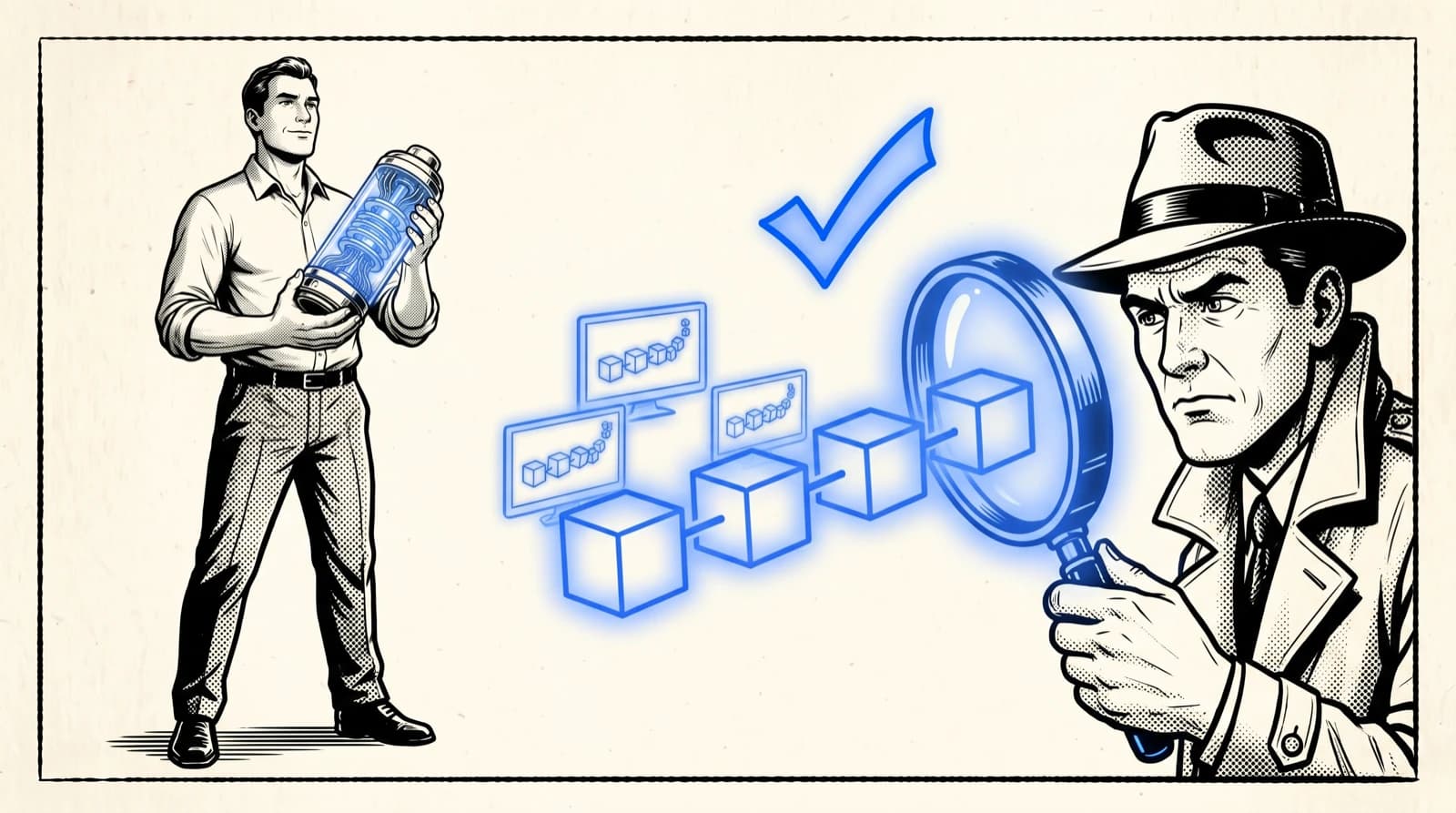
Most of the time, when someone tells you a thing is true, you have to take their word for it. A website says a document was filed on a certain date, and you believe the website. A company says your invention was registered first, and you believe the company. The trouble is obvious the moment you imagine the website going dark or the company changing its story. Everything you were relying on lived behind their door, and now the door is closed.
Label 309 is built the other way around. Two of its core rules make trust unnecessary: anyone may publish a record, and a verifier never has to trust whoever did. The standard calls these being issuer-agnostic and standalone-verifiable.
A record that lives everywhere, not somewhere
Think of how a private ledger works. One company keeps the book. If you want to know what it says, you ask them, and you hope they answer honestly and stay in business. The book is in one place, and that place is a single point of failure.
A public blockchain is the opposite of a private book. Picture the same ledger copied onto thousands of independent computers around the world, none of them in charge, all of them constantly checking each other. To change what the ledger says, you would have to quietly rewrite the same line in thousands of places at once, against everyone who is watching. In practice, you can't.
When a Label 309 proof is published, its fingerprint and the moment it was recorded go into that public ledger, under metadata label 309. They are not stored on the website you used to make it. They are not stored on any one company's server. They are part of a record that thousands of strangers keep and agree on. The standard deliberately puts no "issuer" field in the record at all — there is no official publisher to trust, and none to impersonate.
Verify it yourself, from scratch
Here is what "no one has to be trusted" means in practice. Suppose someone hands you a transaction reference — a kind of receipt number — and a file they say is the recipe for the best pie ever baked, dated years ago. You don't have to believe them. You can confirm it entirely on your own:
- Pick your own window into the chain. There are many public Cardano explorers — open tools that let anyone read the blockchain. You choose which one. You are not sent to a special site run by the person making the claim.
- Look up the receipt yourself. The explorer shows you the fingerprint that was published and the exact moment the network agreed on it.
- Check the file against it. Run the file through the same simple calculation the publisher used. If you get the same fingerprint, this is the exact file behind that record — and it existed no later than that moment.
Notice who you never had to ask. Not the cook. Not the website. Not any company. You read a public record through a tool of your choosing and did the check with your own hands. Label 309 even spells out, step by step, exactly what a verifier must check — so anyone can build their own and reach the same answer.
Even if everyone disappeared
This is the part that makes the idea durable. Imagine the people who made the record are gone. The inventor has moved on, the company has folded, even the site you first used to publish it has vanished. The proof still stands.
It stands because nothing about it was ever hidden behind a private server. Label 309 keeps no secret on any server that a verifier would need — there is nothing a vanished company could take down with it. The fingerprint and its timestamp are out in the open, on a chain that doesn't depend on any of those people staying online. As long as the public blockchain exists — and it is kept alive by thousands of computers with no single owner — anyone, anywhere, can still do the same check and reach the same answer.
That's also why it doesn't matter which explorer you use. They are all reading the same shared ledger. An honest one and a dishonest one would have to show you the same record, because the record isn't theirs to change. A bad explorer can stall, or pretend a record isn't there — but it can't forge one, because it doesn't hold anyone's keys. If you're cautious, you can check through two of them and make sure they agree.
Trust the math, not the messenger
A Label 309 proof asks you to trust only two things: a calculation you can run yourself, and the public Cardano ledger that no single party controls. The publisher, the website, and the company are all messengers — and you can check the message without trusting any of them. The precise rules a verifier follows live in the spec.